What Is the Best Nap Time? How Long and When to Nap
You have a gap in the afternoon, your eyes are heavy, and you want to come back sharper, not groggier. Whether a nap helps or hurts comes down to two numbers: how long you sleep and what time you lie down.
 Alarm Clock Planner is an iPhone appPoint your iPhone camera at the code to install it.
or text me the link
The short answer
For a daytime nap, the research points to a nap of about 10 to 20 minutes, taken in the early afternoon. In a lab study that compared 5, 10, 20 and 30 minute naps after a short night, the 10 minute nap gave the fastest and broadest boost, the 20 minute nap helped after a short delay, and the 30 minute nap left people groggy at first (see nap length). A review of the nap research names early afternoon as the most favourable time to nap (see time of day).
The timing tool matters less than you would think, as long as it rings. Any iPhone alarm set 10 to 20 minutes out does the job. What goes wrong in practice is the math at the moment you are tired, and an alarm that you oversleep because you set it for the wrong time. The nap timer section below covers both.
How long should a nap be?
The clearest data comes from a 2006 study in the journal Sleep. Twenty four healthy young adults slept about 5 hours at home, then napped at 3 PM and were tested for 3 hours afterwards. Each nap length was counted in minutes of actual sleep, not minutes lying down.
| Nap length | What happened | Verdict |
|---|---|---|
| 5 minutes | Few benefits compared with no nap | Too short |
| 10 minutes | Better alertness and performance right away, some gains lasting up to 155 minutes | Best |
| 20 minutes | Gains appeared about 35 minutes after waking and lasted up to 125 minutes | Good |
| 30 minutes | Worse alertness right after waking, then gains up to 155 minutes | Grogginess |
A later review by the same research group summed up the wider literature the same way: brief naps of 5 to 15 minutes bring benefits almost immediately that last 1 to 3 hours, while naps longer than 30 minutes cause a short spell of impairment after waking, followed by better performance that can last many hours.
Two details are worth knowing before you pick a number:
- Count sleep, not time in bed. If you need a few minutes to drift off, a 20 minute alarm gives you roughly 10 to 15 minutes of real sleep. That lands close to the best result in the table above.
- Longer awake, longer nap. The same review found that the longer you have been awake beforehand, the more a longer nap pays off compared with a brief one. A short nap suits a normal day. A long one suits the afternoon before a night shift.
The US workplace safety institute NIOSH gives practical advice in the same range for people on a daytime schedule: a brief nap of under 20 minutes, with an alarm set for 15 to 30 minutes to wake up.
Why a longer nap can leave you groggier
The fog after a nap has a name: sleep inertia. NIOSH describes it as a temporary disorientation and decline in performance or mood after waking, with slower reactions and weaker short term memory. It usually lasts 30 to 60 minutes and has been seen lasting up to 2 hours.
The cause is depth of sleep. According to NIOSH, sleep gets deeper the longer you sleep and reaches the deepest stage, slow wave sleep, in about an hour. Waking from that stage is when functioning can drop considerably. A short nap ends before you get there, so the grogginess is smaller and clears faster.
There is one exception. If you are badly short of sleep, NIOSH notes that your brain can reach deep sleep more quickly, so even a short nap can leave you groggy for longer. On those days, give yourself extra time before anything that needs a clear head.
How to shake it off, or wake someone else up
NIOSH lists three things that helped people become alert faster after a nap:
- Bright light. Open the blinds or turn on the lights.
- Wash your face. Washing the face also helped people wake up faster.
- Caffeine. In one study, 100 mg of caffeine on waking reduced sleep inertia faster than a placebo.
If you are waking someone else from a nap, the same three apply: light, water, and time before they drive or make decisions. Waking them before the nap passes the 20 minute mark spares them most of the fog in the first place.
What is the best time of day to nap?
Early afternoon. The review of the nap research calls it the most favourable time to nap, and there is a biological reason for it.
The afternoon slump has a name: the post lunch dip. A review in Clinics in Sports Medicine describes it as a real dip in performance during the midafternoon hours, linked to a rise in sleepiness at that time of day. It can happen even when you have skipped lunch and do not know what time it is, because it is rooted in the body clock. A high carbohydrate lunch makes it worse.
NIOSH maps the same rhythm for people on a regular daytime schedule. The strongest drive for sleep comes between 2 and 5 AM, with a smaller window from about 2 to 4 PM. That afternoon window is when falling asleep for a nap comes easiest.
It also tells you when not to nap. NIOSH names the evening, 1 to 3 hours before your usual bedtime, as one of the hardest times to fall asleep. A brief nap earlier in the day does not disrupt sleep at night, according to NIOSH, because it does not use up the pressure for sleep that builds while you are awake. So keep naps short and keep them in the afternoon.
Can you nap in the morning?
You can, but it is harder to fall asleep then. NIOSH lists late morning, around 11 AM to noon, as a low point in the body's drive for sleep. You may lie down and simply stay awake.
A morning nap makes most sense when your night was cut short or ended very early, for example after an early flight or a night shift. The more hours you have been awake, the easier sleep comes and the deeper it gets, so the usual rules still apply: keep it to about 20 minutes unless you are deliberately catching up, and set an alarm, because a nap on a short night can slide into deep sleep fast (see sleep inertia).
Can you nap in your car?
Yes, and if you are drowsy behind the wheel, it is one of the few things that actually helps. NIOSH advice for drowsy drivers is to find a safe place to stop and take a nap, noting that even 15 to 20 minutes can help. It also says the equivalent of 2 cups of coffee can temporarily raise alertness.
The car itself adds risks of its own, and how to nap safely in your car covers carbon monoxide from a snow-blocked tailpipe and how fast a parked car heats up in the sun.
The two work well together. Caffeine takes about 30 minutes to kick in, NIOSH notes, so a coffee right before a short nap can start working around the time you wake. Practical points for a car nap:
- Park somewhere safe and legal, away from traffic, and turn the engine off.
- Set the alarm before you recline, not after, so you do not doze off first.
- Give yourself a few minutes to wake fully before you pull out. Sleep inertia slows reactions, which matters more in a car than anywhere else.
The best nap timer on iPhone
A good nap timer has three jobs: it is fast to start, it counts the minutes for you, and it rings even when the phone is on Silent or in a Focus. For the last part, an alarm is the documented route: Apple describes alarms built on its AlarmKit framework as alerts that break through silent mode and the current Focus when they fire.
With the built-in Clock app you can start a 20 minute Timer, or work out what time it will be in 20 minutes and create a one-off alarm. Both work, and our guide to setting a quick nap alarm walks through them. The alarm route means arithmetic at the moment you are least sharp and an alarm list that slowly fills with leftover nap times.
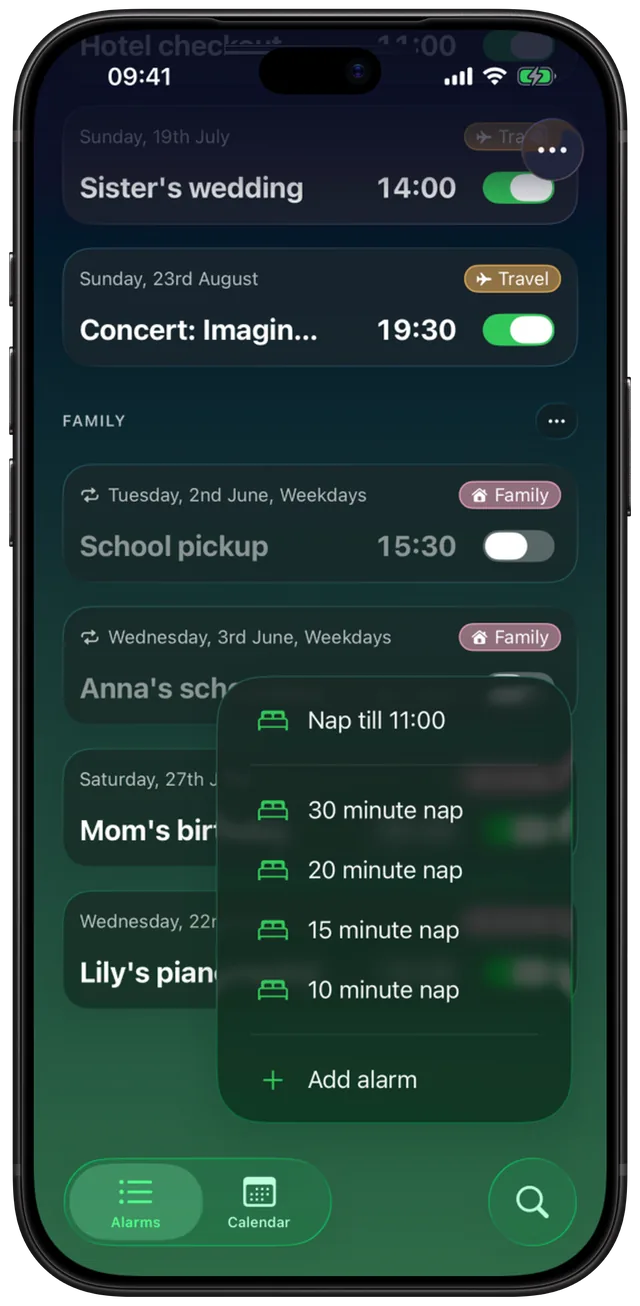
Alarm Clock Planner puts preset naps under the add button, so the research numbers above are one tap away:
- Press and hold the round add button at the bottom of the alarm list.
- Tap 10, 15, 20 or 30 minute nap. For a 10 to 20 minute nap of real sleep, 20 is a good default if you take a while to drift off, 10 or 15 if you fall asleep fast.
- A short confirmation shows when the nap alarm will ring. Put the phone down.
A few details that matter for napping:
- Full minutes. A preset counts from the start of the next minute, so a 15 minute nap tapped at 14:00:35 rings at 14:16 and you get at least the full 15 minutes.
- Nap till the hour. The last option rings at the next full hour, handy when you need to be up for a 15:00 call.
- Longer naps. For a planned long nap, such as before a night shift, create a regular alarm for the exact wake time instead of a preset.
- Free. Naps do not count toward the free tier's limit of 3 alarms.
If a 20 minute nap keeps turning into an hour of snoozing, cap it. The app lets you set snooze from 1 to 30 minutes and limit how many times an alarm can be snoozed, covered in the snooze time guide. And if you nap with the phone on Silent, the silent mode guide explains what still rings and what does not.
Frequently asked questions
What is the best nap time?
A nap of about 10 to 20 minutes in the early afternoon. In a study comparing 5, 10, 20 and 30 minute naps, 10 minutes gave the quickest boost and 30 minutes caused grogginess on waking. A review of nap research names early afternoon as the most favourable time.
What is the best nap timer?
Any timer that is quick to start and rings even when the phone is on Silent. On iPhone the Clock app's Timer is quick to start, and Apple documents that AlarmKit alarms break through silent mode and Focus. Alarm Clock Planner adds one-tap 10, 15, 20 and 30 minute nap presets so you skip the arithmetic.
Can you nap in the morning?
Yes, but it can be harder to fall asleep. NIOSH lists late morning, around 11 AM to noon, as a low point in the drive for sleep. A morning nap works best after a short or early night.
Can you nap in your car?
Yes. NIOSH advises drowsy drivers to find a safe place to stop and nap, noting that even 15 to 20 minutes can help. Caffeine just before the nap can start working around the time you wake, and you should give yourself a few minutes to wake fully before driving.
Why do I feel worse after a nap?
That is sleep inertia, grogginess after waking from deeper sleep. Sleep reaches its deepest stage in about an hour, and waking from it can impair you for 30 to 60 minutes. Keeping naps under about 20 minutes avoids most of it.
How do you wake someone up from a nap?
Bright light, washing the face and caffeine all helped people become alert faster after a nap in studies NIOSH cites. Then give them some minutes before they drive or make decisions, while the grogginess wears off.
Sources
- Brooks and Lack, A brief afternoon nap following nocturnal sleep restriction: which nap duration is most recuperative? Sleep, 2006
- Lovato and Lack, The effects of napping on cognitive functioning. Progress in Brain Research, 2010
- Monk, The post-lunch dip in performance. Clinics in Sports Medicine, 2005
- NIOSH training for nurses, Module 7: Nap duration
- NIOSH training for nurses, Module 7: Nap times
- NIOSH training for nurses, Module 7: Sleep inertia
- NIOSH training for nurses, Module 11: Drowsy driving
- Apple Developer, WWDC25: Wake up to the AlarmKit API