Can You Nap in Your Car? How to Do It Safely
You are behind the wheel, your eyelids are heavy, and the next stop is still an hour away. Or you are parked between shifts with 20 minutes to spare. Either way, the car is the only bed you have, and it pays to know how to use it without waking up worse off.
 Alarm Clock Planner is an iPhone appPoint your iPhone camera at the code to install it.
or text me the link
The short answer
Yes. If you are getting drowsy while driving, a short nap in a parked car is one of the few things that actually helps. NIOSH, the US workplace safety institute, tells drowsy drivers to pull off at the next exit or rest area, stop driving, and get sleep or caffeine, and notes that even 15 to 20 minutes of sleep can help. Coffee taken right before a short nap adds to the effect (see the coffee nap).
Three things make a car nap safe instead of risky: where you stop, what the engine and cabin are doing while you sleep (see engine, heat and cold), and how you wake up and get going again (see before you drive off). Any iPhone alarm can handle the waking part. Set it before you recline, not after, and keep the nap to about 20 minutes so you wake from light sleep.
When to pull over
The sooner you stop, the shorter the nap you need. NIOSH lists these warning signs of drowsy driving:
- Difficulty focusing, frequent blinking or heavy eyelids
- Daydreaming, wandering or disconnected thoughts
- Trouble remembering the last few miles, missing exits or traffic signs
- Yawning repeatedly or rubbing your eyes
- Trouble keeping your head up
- Drifting from your lane, tailgating, or hitting a shoulder rumble strip
- Feeling restless and irritable
If you notice one of these, treat it as the signal to stop at the next safe place, not as something to push through with the window down and the radio up.
Where to park
Pick a spot where you can sleep for 20 minutes without being in anyone's way and without worrying about who is around you:
- Rest areas and service stations. NIOSH names the next exit or rest area as the place to stop. They are built for exactly this, with lighting and other people nearby.
- A well lit car park. Away from the driving lanes, facing out so you can leave without reversing while still groggy.
- Not the hard shoulder. A shoulder is for emergencies, and a parked car there sits a few feet from moving traffic.
Parking rules differ from place to place, and some car parks limit how long you may stay or ban sleeping in vehicles. Read the signs before you settle in. For a 20 minute nap at a rest area, time limits are unlikely to matter, but an overnight stay is a different question.
Once parked, lock the doors, put the seat back as far as is comfortable, and keep the key where you can reach it.
Engine, heat and cold
This is the part that turns a car nap from helpful to dangerous, so it is worth getting right.
Carbon monoxide
An engine produces carbon monoxide, a gas the CDC describes as odorless, colorless and deadly. If the exhaust cannot get away, it can build up quickly inside the vehicle and poison anyone inside. Two situations are named in CDC guidance:
- Snow around the tailpipe. A CDC report on a 1996 blizzard traced poisonings to people sitting in idling cars whose exhaust pipes were blocked by snow. The gas can seep into the cabin through leaks or cracks in the floorboard. If you run the engine in winter, check first that the tailpipe is clear.
- Enclosed spaces. The same report advises against running engines in enclosed spaces such as garages.
Early symptoms of carbon monoxide poisoning are nonspecific: headache, dizziness, weakness, nausea, visual disturbances and confusion. The trouble is that a sleeping person does not notice them. The simple rule for a short nap is to turn the engine off.
Heat
A parked car in the sun warms fast. The US National Weather Service notes that on an 80 degree day, the temperature inside a car can rise 30 to 35 degrees in half an hour. It also says that cracking the windows may increase air flow a bit, but studies have shown this provides little relief.
In warm weather, park in shade, keep the nap short, and treat the alarm as a safety device rather than a convenience. A nap that runs an hour over in a hot car is a different situation from one that ends on time.
Cold
In cold weather, put on your coat or use a blanket instead of leaving the heater running. If you do run the engine for warmth, the carbon monoxide points above apply: tailpipe clear of snow, and never in a closed space.
How long to sleep
About 15 to 20 minutes. NIOSH advises people on a daytime schedule to keep a nap brief, under 20 minutes, and to set an alarm for 15 to 30 minutes to wake up. The reason is depth of sleep: sleep gets deeper the longer it lasts and reaches the deepest stage, slow wave sleep, in about an hour.
Waking from deep sleep brings sleep inertia, which NIOSH defines as a temporary disorientation and decline in performance or mood after waking. It can last 30 to 60 minutes and has been seen lasting 2 hours, and if you are sleep deprived it can last longer. That matters more in a car than anywhere else, because the next thing you do is drive. A short nap ends before you reach deep sleep, so there is less fog to wait out.
You do not need to fall fully asleep for it to count. In the simulator study below, naps that were only dozing still helped. For more on nap length and time of day, see how long to nap and when.
The coffee nap
Caffeine and a short nap work well together. NIOSH says caffeine takes about 30 minutes to begin working, and suggests taking it before a short nap to get the benefit of both. It puts the dose for a temporary lift at the equivalent of 2 cups of coffee, and stresses that caffeine is a temporary aid, not a replacement for sleep.
The strongest evidence for drivers comes from a 1997 study by Reyner and Horne in the journal Psychophysiology. Twelve sleepy people drove a monotonous two hour afternoon route in a car simulator after a 30 minute break, during which they had a placebo, caffeine, or caffeine plus a short nap. Caffeine alone cut sleep related driving incidents to 34% of the placebo level. Caffeine plus the nap cut them to 9%.
In practice:
- Buy or pour a coffee at the stop.
- Drink it straight away, before you recline.
- Set an alarm for 15 to 20 minutes (see setting the alarm).
- Sleep. The caffeine starts working around the time the alarm rings.
Setting the alarm on iPhone
A car nap alarm has one job: ring on time, loud enough, no matter what mode the phone is in. Two things can get in the way. The phone may be on Silent, and when you drive, a Driving Focus can switch on automatically, by detected motion, car Bluetooth or CarPlay, according to Apple Support. While it is on, notifications are silenced or limited. Alarms are a separate case: Apple documents that an alarm built on its AlarmKit framework breaks through silent mode and the current Focus when it fires. The silent mode guide explains what rings on Silent and what does not.
With the built-in Clock app you can start a Timer, or work out what time it will be in 20 minutes and add a one-off alarm. Our guide to setting a quick nap alarm walks through both. The catch is that you are doing that arithmetic exactly when you are least sharp.
Alarm Clock Planner keeps preset naps under its add button, so a car nap takes one press and one tap:
- Press and hold the round add button at the bottom of the alarm list.
- Tap 10, 15, 20 or 30 minute nap. For a car nap, 20 gives you time to drift off and still wake before deep sleep. Pick 15 if you fall asleep fast.
- A short confirmation shows when the nap will ring. Put the phone somewhere you will hear it and recline.
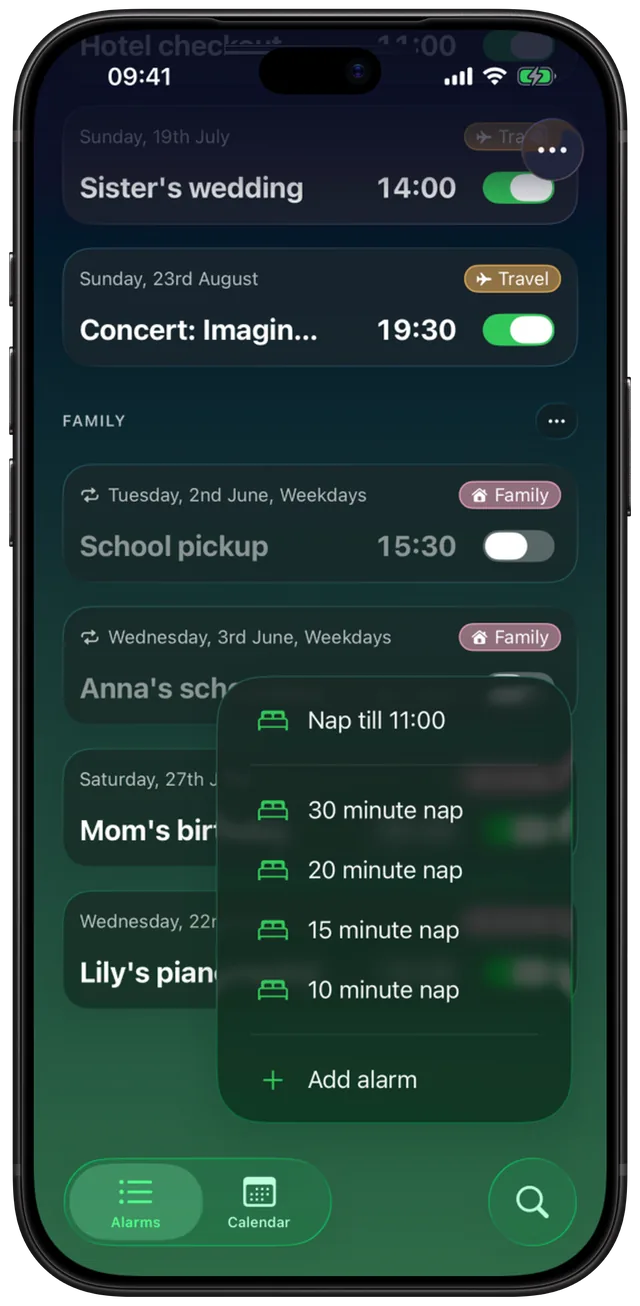
The nap is scheduled as an AlarmKit alarm, so it rings on Silent and through a Focus. Each preset counts from the start of the next minute, so you always get the full length. Naps are free and do not count toward the free tier's limit of 3 alarms.
One trap: the snooze button. Each snooze pushes you deeper into sleep and into a longer fog before you drive. In Alarm Clock Planner you can pick a snooze length between 1 and 30 minutes and limit how many times an alarm may be snoozed, covered in the snooze time guide. For a car nap, the safest snooze is none: when the nap alarm rings, tap Stop, not Snooze.
Before you drive off
The nap is not over when the alarm rings. Give yourself a few minutes before you pull out:
- Get light. Open the door or step out into daylight. NIOSH reports that bright light helps restore alertness faster after a nap.
- Wash your face if there is a tap nearby. NIOSH lists this too.
- Walk for a minute and check that you feel clear before you start the engine.
- Check yourself honestly. If the warning signs from the list above come back soon after you set off, stop again. A nap buys time, it does not replace a night's sleep.
Frequently asked questions
Can you nap in your car?
Yes. NIOSH advises drowsy drivers to pull off at the next exit or rest area and get sleep or caffeine, noting that even 15 to 20 minutes of sleep can help. Park somewhere safe and legal, turn the engine off, and set an alarm before you recline.
Is it safe to sleep in your car with the engine running?
It carries a carbon monoxide risk. The CDC warns that if the tailpipe is blocked, for example by snow, carbon monoxide can build up quickly inside the car, and it advises against running engines in enclosed spaces such as garages. For a short nap, turning the engine off removes the risk.
How long should a nap in the car be?
About 15 to 20 minutes. NIOSH recommends a brief nap under 20 minutes with an alarm set for 15 to 30 minutes, because sleep reaches its deepest stage in about an hour and waking from it can leave you groggy for 30 to 60 minutes.
Does coffee before a nap help drowsy drivers?
Yes. In a 1997 driving simulator study, caffeine plus a short nap cut sleep related driving incidents to 9% of the placebo level, against 34% for caffeine alone. Caffeine takes about 30 minutes to start working, so drink it just before the nap.
Is it safe to nap in a car on a hot day?
Only with care. The National Weather Service notes that on an 80 degree day a car's interior can rise 30 to 35 degrees in half an hour, and cracked windows give little relief. Park in shade, keep the nap short and make sure the alarm will ring.
Will my iPhone alarm ring if Driving Focus is on?
Driving Focus silences or limits notifications. Apple documents that alarms built on AlarmKit break through silent mode and the current Focus when they fire, and Alarm Clock Planner's nap alarms are scheduled that way.
Sources
- NIOSH training for nurses, Module 11: Drowsy driving countermeasures
- NIOSH training for nurses, Module 11: Warning signs of drowsy driving
- NIOSH training for nurses, Module 7: Sleep inertia
- NIOSH training for nurses, Module 7: Nap duration
- Reyner and Horne, Suppression of sleepiness in drivers: combination of caffeine with a short nap. Psychophysiology, 1997
- CDC, Clear snow from tailpipes
- CDC MMWR, Carbon monoxide poisonings associated with snow-obstructed vehicle exhaust systems, 1996
- National Weather Service Little Rock, Hot cars
- Apple Support, Use the Driving Focus on your iPhone
- Apple Developer, WWDC25: Wake up to the AlarmKit API